
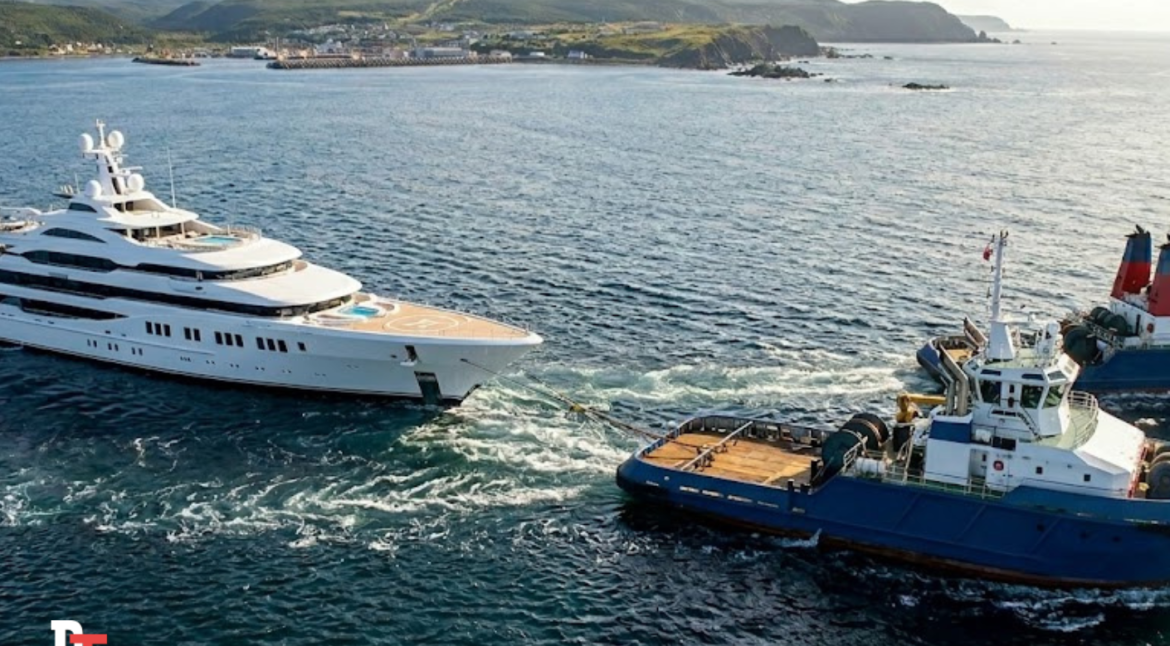
Key Takeaways:
Coastwise towing involves moving vessels along a coastline, staying within relatively close range of safe harbors, and is governed by domestic regulations like the Jones Act. Ocean towing involves long-distance transits across open seas, requiring higher bollard pull, specialized deep-sea rigging, and autonomous operations far from port assistance.
____________________________________________________________________________________________________
Navigating the vast blue expanse of the maritime world requires more than just a sturdy hull and a compass; it requires a deep understanding of the logistics that move assets from point A to point B.
For yacht owners, fleet managers, and maritime enthusiasts, the terminology can often overlap. Two terms frequently used, yet often misunderstood, are ocean towing vs. coastwise towing.
At Dann Ocean Towing, we specialize in the high-stakes world of marine transportation. Whether you are looking for Tampa yacht towing services or need a “dead-ship” moved across the Atlantic, understanding these distinctions is vital for the safety of your vessel and the efficiency of your voyage.
Defining the Horizon: Coastwise Towing
Coastwise towing refers to the movement of a vessel along a coastline, typically staying within the Exclusive Economic Zone (EEZ) and often within sight of land or within relatively short distances from a safe harbor.
Characteristics of Coastwise Operations:
- Predictability: While no sea is truly “predictable,” coastwise routes allow for more frequent weather window monitoring and quicker access to refuge if a storm rolls in.
- Regulatory Framework: Coastwise trade in the United States is governed heavily by the Jones Act, ensuring that vessels transporting goods between U.S. ports are American-built, owned, and crewed.
- Equipment Specs: The tugs used for coastwise work are often versatile, designed for maneuverability in tighter coastal channels while maintaining enough power to handle coastal swells.
For those seeking Tampa yacht towing services, coastwise towing is the standard for moving luxury vessels between Florida’s Gulf Coast ports or taking a yacht up the Eastern Seaboard for the summer season.
Crossing the Deep: Ocean Towing
Ocean towing (or “deep sea towing”) is the big brother of maritime transport. This involves crossing open oceans, where the tug and its tow are hundreds, if not thousands, of miles from the nearest port.
The Challenges of the Open Sea:
- Duration: These voyages can last weeks or even months.
- Self-Sufficiency: There is no “pulling over” in the middle of the Atlantic. The crew must be prepared for every mechanical or atmospheric contingency.
- Dynamic Loading: The tug must account for massive wave periods and sustained winds that are far more intense than those found in sheltered coastal waters.
Technical Specs: Bollard Pull for Yacht Transport
When comparing ocean towing vs. coastwise towing, the conversation inevitably turns to power. In the towing industry, we measure this power through bollard pull.
Bollard Pull: The conventional measure of the pulling power of a watercraft, similar to the horsepower or “towing capacity” of a truck. It is the static force exerted by a ship on a fixed shore-mounted bollard at full throttle.
Why Bollard Pull Matters for Yachts
When calculating the necessary bollard pull for yacht transport, our engineers consider the displacement of the yacht, the projected windage (surface area exposed to wind), and the environmental factors of the route.
- Ocean Towing: Requires a higher reserve bollard pull to maintain control against heavy ocean swells and consistent deep-sea currents.
- Coastwise Towing: Requires precise power to ensure the vessel remains in the channel and handles tidal currents effectively.
The Art of the Dead-Ship Yacht Towing
Not every tow involves a vessel that can assist with its own power. Dead-ship yacht towing is a specialized service where the vessel being towed has no propulsion, steering, or functional power systems.
This is common during:
- Refit Logistics: Moving a yacht to a shipyard for engine overhauls.
- Repossessions or Sales: Moving a vessel that has been idle.
- Emergency Recovery: Transporting a vessel after a major mechanical failure.
Dead-ship tows require a higher level of rigging expertise. Because the “dead” vessel cannot steer itself, the tug must act as both the engine and the rudder, often requiring a “tail-tug” in narrow channels to prevent the yacht from swinging.
Speed vs. Safety: Finding the Sweet Spot
One of the most common questions we receive is: “How fast can you move my boat?”
The safe towing speed for luxury vessels is rarely about the maximum speed the tug can achieve. Instead, it is dictated by the hydrodynamics of the towed vessel.
| Factor | Impact on Speed |
| Hull Design | Displacement hulls have a “hull speed” limit; exceeding this creates massive drag. |
| Sea State | In heavy seas, speed must be reduced to prevent shock loading on the towline. |
| Rigging Strength | Speed must never exceed the safe working load (SWL) of the towing bridal. |
Generally, for high-value luxury yachts, a speed of 6 to 10 knots is the “goldilocks zone,” fast enough to make progress, but slow enough to ensure structural integrity.
Why Choose Tampa Mega Yacht Towing Services?
Tampa has emerged as a premier hub for maritime logistics. With its deep-water access and proximity to the Caribbean, it is a strategic starting point for both coastwise and ocean towing operations.
By choosing a local expert like Dann Ocean Towing, you benefit from:
- Local Knowledge: Understanding specific tidal nuances of the Florida coast.
- Strategic Positioning: Rapid deployment for vessels entering or exiting the Gulf.
- Versatile Fleet: Tugs equipped for the unique “short-chop” of the Gulf and the long swells of the Atlantic.
FAQs
Is ocean towing more expensive than coastwise towing?
Generally, yes. Ocean towing requires larger vessels with higher fuel capacity, more extensive crew requirements, and specialized deep-sea gear, whereas coastwise towing can often be performed by smaller, more fuel-efficient tugs.
What is the “Jones Act,” and does it affect my yacht tow?
The Jones Act requires goods (and sometimes vessels) moved between U.S. ports to be carried by U.S.-flagged ships. For coastwise towing between two American cities, you must use a compliant provider like Dann Ocean Towing.
Can you tow a yacht with its engines running?
While possible, it is rarely done for long distances. Most tows are conducted as “dead-ships” or with minimal systems active to reduce wear and tear on the yacht’s propulsion system.
How do you prevent the yacht from being damaged during a tow?
We use specialized towing bridles, soft-line attachments where necessary to protect the finish, and constant monitoring of the safe towing speed for luxury vessels to prevent structural stress.
The Verdict: Ocean vs. Coastwise
The choice between ocean towing vs. coastwise towing ultimately depends on your destination and the level of risk management required.
- Choose Coastwise if you are moving between domestic ports and want a cost-effective, efficient transit with frequent check-ins.
- Choose Ocean if you are moving across international waters or navigating open-sea stretches where specialized equipment and high bollard pull are non-negotiable.
Ready to move? Contact Dann Ocean Towing today at (813) 251-5100 to discuss your next voyage. Experience the gold standard in maritime transport.