
Key Takeaways:
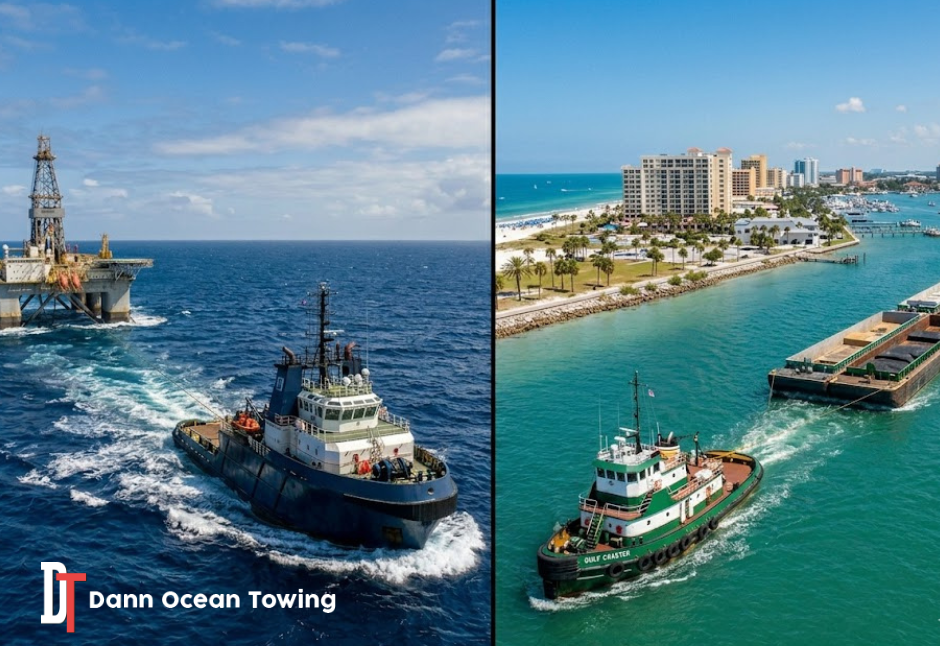
Distance Boundaries: Coastwise towing operates within 20 nautical miles of the shore. Ocean towing handles routes extending past this 20-mile limit into open, international waters.
Vessel Power: Nearshore operations use smaller coastal tugs. Open-ocean transport requires heavy-duty towing vessels with up to 4600 horsepower to manage severe sea states.
Specialized Equipment: Ocean transit requires high bollard pull and specialized winches to control the catenary, which acts as a shock absorber in deep water.
Regulatory Compliance: Both transportation types must satisfy US Coast Guard Subchapter M safety rules, but ocean-bound vessels face stricter hull and safety certifications.
_________________________________________________________________________________________________________
The primary difference between ocean towing and coastwise towing is distance and regulation. Coastwise towing occurs within 20 nautical miles of the shoreline, governed by nearshore safety rules. Ocean towing extends beyond this 20-mile limit into international waters.
This requires larger towing vessels with higher horsepower, advanced winch systems, and specialized offshore crew certifications.
Selecting the right marine transportation strategy is a major step for marine construction, dredging, and international transport projects. A wrong choice can lead to regulatory delays or equipment failure.
Understanding the operational boundaries of Ocean Towing vs. Coastwise Towing protects your cargo and keeps your project on schedule across the East Coast or the Gulf of Mexico.
What defines coastwise towing operations?
Coastwise towing covers marine transport along the shoreline, typically within 20 nautical miles of the coast. These coastal tugboat operations move cargo between regional ports without entering deep ocean waters.
These services support marine construction by moving aggregates, pipes, or dredging equipment. Captains rely on localized weather forecasts because they operate close to safety.
Key aspects of nearshore towing include:
- Favorable sea states protected by the coastline.
- Lower deadweight tonnage requirements for smaller barge transportation services.
- Frequent access to safe harbors during sudden weather changes.
- Towing vessels with lower horsepower ranges suited for shorter trips.
What defines international marine towage and ocean towing?
Ocean towing involves moving large structures across open seas, far past the 20-mile coastal boundary. This sector handles high-complexity, long-range transport across the Atlantic or Pacific oceans.
Towing ships built for open water must withstand harsh environments. Fuel efficiency becomes a major factor during long voyages, requiring precise propulsion management.
Managing offshore vs. nearshore towing requires distinct capabilities:
- High bollard pull to manage deep-water resistance and heavy towing ships.
- Heavy-duty winches to control the catenary, which is the curve of the towline underwater.
- Advanced weather routing systems to manage open ocean sea states.
- Vessels with 1800 to 4600 horsepower are built for extended durability.
How do marine towing regulations affect your project?
Federal rules dictate exactly which towing vessels can perform specific jobs. The US Coast Guard enforces strict standards under Subchapter M to verify vessel safety and crew licensing.
Compliance checks cover:
- Vessel hull inspections for open-ocean durability.
- Specific safety management systems for crew safety.
- Proper horsepower and equipment certification for the route.
FAQs
What is the USCG distance limit for coastwise towing?
The US Coast Guard defines coastwise routes as those within 20 nautical miles of the shoreline.
Why do ocean towing ships need more horsepower?
Deep ocean routes face rougher sea states and stronger currents. Higher horsepower, ranging up to 4600 HP, provides the necessary bollard pull to control heavy barges safely in open water.
What is a catenary in marine transportation?
A catenary is the natural curve in a towline between two vessels. This curve acts as a shock absorber against heavy waves in open ocean environments.
Does Subchapter M apply to both towing types?
Yes. Subchapter M regulations apply to most commercial towing vessels in the United States, establishing safety standards for both nearshore and offshore operations.
Partner with a Proven Marine Transportation Leader
Planning a complex move across the Gulf of Mexico or across the Atlantic? Consult with our logistics experts to determine the safest route for your cargo. Dann Ocean Towing brings over 100 years of experience and fifth-generation leadership to every project.
With a fleet of 16 seagoing tugs ranging from 1800 to 4600 HP, we handle everything from local coastal tugboat operations to international marine towage.
TRUST US, YOU WILL BE MOVED. Call 813-251-5100 for a project consultation.